Pitch deck design services in 2026: cost, timelines and what investors actually read


Pitch deck design services in 2026: vendor prices, what a $1,000 deck includes, how long investors read (Papermark, DocSend) and 8 rules we design by.
Key takeaways:
- In November 2026, published pitch deck design prices run from under $20 a slide (24Slides) to $6,000 or more for strategy plus design (Waveup, Slidebean); Cosmos Studio starts from $1,000 for designing your content into up to 20 slides in about a week.
- Papermark's 2026 report (24,541 decks): half of investor views end within 77 seconds, the average view lasts 4.0 minutes and 44% of investors reach the last slide.
- Shorter decks get finished: 60% of investors complete an 8-page deck, 51% a 12-page deck and 38% a 20-page deck (Papermark, 2026).
- In a 2025 trial with nearly 35,000 investors (Blaseg and Mayer, AOM), better design raised reading time by 35%, but only better content raised the likelihood to invest.
- DocSend's often-quoted 3 minutes 44 seconds comes from a 2015 study; its weekly index read 2:18–2:42 in 2023–2024.
- Decks with traction in the first three slides got 20% more views (Papermark, 2026).
A pitch deck design service turns your story and numbers into slides an investor can follow in about a minute. Published prices in November 2026 run from under $20 a slide to $6,000 or more for strategy and design. At Cosmos Studio a deck starts from $1,000: you bring the content, and we design and finish up to 20 slides in about one week.
I'm Illia Kulbachnyi, CEO of Cosmos Studio. Our team has designed up to 100 pitch decks in recent years. Below is what the service includes, what it costs at studios that publish prices, how long investors really read, what the research says about design, and the rules we use on every deck.
What does a pitch deck design service include?
It depends on how much of the work you hand over. Most offers fall into three levels:
- Design only. You bring the text and numbers. The designer builds the slide system, charts, icons and layouts in your brand.
- Story and design. The studio also works on the order of slides and the wording. Vendors price this higher because writing takes longer than layout.
- Design with 3D and motion. Product renders and animation for products that are hard to photograph or still in development.
Before you compare offers, decide which deck you need. A teaser for a cold email, a deck you send ahead of a meeting and a deck you present live are different documents, even when the story is the same.

| Deck | Slides | When you use it | What matters |
|---|---|---|---|
| Teaser | 5–7 | Cold email, intro from a friend | Reads on its own, one number per slide, ends with a request to meet |
| Send-ahead deck | Up to 20: 12–16 core + appendix | Before the first meeting | Readable without you. Papermark's 2026 data puts the sweet spot at 9–16 pages, with 12 pages getting the most views |
| Live pitch | 8–10 | You present on a call or on stage | Large type and few words. Guy Kawasaki's 10/20/30 rule (2005) is still a fair benchmark: 10 slides, 20 minutes, no font under 30 points |
| Data room | No limit | Due diligence | Financial model, contracts, cap table. Papermark advises a separate link per firm for sensitive material |
The teaser and live ranges are common ranges, not findings of a study. The send-ahead core of 12–16 slides is where the 2026 reading data points; with the appendix, the decks we design are usually up to 20 slides.
How much does pitch deck design cost in 2026?
From under $20 a slide for a quick fix-up to $6,000 or more for a full package with strategy, writing and design. Most studios don't publish prices. The ones below do, and every figure comes from the vendor's own page, checked on November 23, 2026. Treat them as list prices, not market averages.
| Option | Price | Time | What you get | Source |
|---|---|---|---|---|
| 24Slides, per slide | $16 fix-up, $43 redesign, $66 redraw (pay as you go; less on monthly plans) | 24–72 hours | Slide-by-slide work on your existing deck, no story work | 24Slides |
| Slidebean, design | $799 | 4 business days | Design of up to 20 slides, 2 rounds of design revisions | Slidebean |
| Cosmos Studio | From $1,000 | About 1 week | Design of your content: up to 20 slides in your brand voice and colours, 2 rounds of small revisions, delivered as a link, HTML or PDF | Cosmos Studio |
| Pitch Deck Creators, design | $1,500 | 48 hours | Design of up to 15 slides | Pitch Deck Creators |
| Pitchfast (formerly deckworks.co) | $2,499 or $3,499 | From 2–3 weeks | 15 slides and 2 revision rounds, or 20 slides with storytelling and a pitch audit | Pitchfast |
| Pitch Deck Creators, writing and design | From $5,000 | 7 days | Writing and design of up to 20 slides | Pitch Deck Creators |
| Waveup | Design from $100 a slide; full service from $6,000 | About 2 weeks (10–14 business days), 5–7 if urgent | Strategy, narrative, design and revisions | Waveup |
| Slidebean, strategy sprint | From $6,000 | 3–4 weeks | Writing plus design, with content and design revision rounds | Slidebean |
| Freelancer | $500–3,000 | 7–14 days | Waveup's estimate for a freelance deck | Waveup |
| AI tool (ChatGPT, Claude) | $0–20 a month | Minutes | Waveup's estimate: a fast draft from templates | Waveup |

What does the Cosmos Studio deck from $1,000 include?
You bring the content: the text for each slide, the numbers, product screens and photos. We turn it into a designed deck of up to 20 slides in your brand voice and colours. We tidy the wording, put the slides in a clear order, build the charts and diagrams and add motion. Writing the story from scratch is not part of this package. Two rounds of small revisions are included.
We build the deck in Claude as an animated HTML presentation or in Figma, and the base timeline is about one week. More than 20 slides, or help with the story itself, is quoted after the first call.
You get the deck as a link, which I recommend because it keeps the animation, as HTML files or as a PDF. If you need the deck in PowerPoint, Google Slides or Keynote, the conversion costs extra. You get all the files, and we keep backup copies on our side in case you need an edit before the next round.
Agency, freelancer, AI tool or template: which should you pick?
Pick by what is missing, not by price. If your story is clear and you only need it to look credible, a template or a design-only service is enough. If the story is the problem, pay for someone who will push back on it, because the slides will only make a weak story look neat. AI tools are good for a first draft and for checking structure. Don't send a raw AI deck to investors: it looks like everyone else's, and investors see a lot of them.
How long do investors actually read a pitch deck?
Most views are short. Papermark's 2026 report, built on 24,541 decks and 358,672 investor views, says half of all views end within 77 seconds and one view in six lasts under 10 seconds. The average view is 4.0 minutes, and only 44% of investors reach the last slide.

You will see very different numbers quoted for the same question. They are not contradictions: they measure different things in different years.
| Figure | What it measures | Dataset | Year |
|---|---|---|---|
| 77 s | Half of single views end by this point | Papermark, 24,541 decks, 358,672 views | 2026 report |
| 4.0 min | Average length of one active view | Papermark | 2026 report |
| 18 min | Median total attention per deck across the whole raise | Papermark | 2026 report |
| 4:51 / 3:27 | Average time on desktop / on mobile | Storydoc, 1.3 million sessions | Published Dec 2025, updated Oct 2026 |
| 2:18–2:42 | Average time on deck, weekly readings | DocSend Startup Index | 2023–2024 |
| 1:56 | Average time on seed decks, 20% less than in 2022 | DocSend | 2023 |
| 3:44 | Average time on deck in a study of 200+ decks | DocSend, reported by TechCrunch | 2015, still repeated on DocSend's seed guide updated in 2026 |
Why they differ: a median is lower than an average when many views are short. Papermark counts one session, Storydoc counts sessions by device, DocSend's index counts time on deck across its users. Each company also measures its own customers, so the data leans toward people who use that tool. The safe reading is simple: plan for a first look of about a minute, and make sure the first three slides work on their own.
Does pitch deck design change whether investors invest?
Design gets you read. Content gets you funded. That is the short version of the best study I know on this question.
Daniel Blaseg (Esade) and Stefan Mayer (University of Tübingen) ran a pre-registered randomized controlled trial with nearly 35,000 investors and three online experiments, presented at the Academy of Management meeting in 2025. Better visual design and better substance each raised the time investors spent by 35% and the slides they viewed by 12%. Positive reactions grew by 116% for design and 121% for substance. Only substance raised the likelihood to invest.

So no designer can honestly promise you a round. Good design buys attention: more time, more slides read, a warmer first reaction. What investors do with that attention depends on your numbers, your team and your story. The job of design is to make sure the deck doesn't waste it.
8 rules we follow when we design a pitch deck
These are the rules our team applies on every deck. Where a rule rests on data, the source and year are next to it.
1. Put your strongest proof in the first three slides
The biggest drop in readers happens between slide one and slide two. In Papermark's 2026 data, decks with traction in the first three slides got 20% more views and 9% more total reading time than the typical deck. Put your best number early, not on slide 11.

2. Keep the deck to 20 slides or fewer, with the main story in the first 12–16
The decks we design are usually up to 20 slides. The reason is in the data: every extra page costs readers. Papermark found that 60% of investors finish an 8-page deck, 51% a 12-page deck, 40% a 16-page deck and 38% a 20-page deck (2026). Twelve-page decks got the most views of any length. So the main story goes in the first 12–16 slides, and anything you can't cut goes in an appendix behind the ask.

3. Use an order investors already know
Investors read hundreds of decks, so a familiar order saves them effort. Sequoia's outline is a good base: company purpose, problem, solution, why now, market potential, competition and alternatives, business model, team, financials, vision. Change the order only when you have a reason, for example to bring strong traction forward.

4. Give each slide one idea and write the conclusion as the headline
Kevin Hale's Y Combinator advice from 2015 still holds: slides should be legible, simple and obvious, understood at a glance. A headline like "Revenue grew 3x in 2026" does more work than "Revenue". If a slide needs two headlines, it is two slides.

5. Don't skip the slides investors spend time on
The two big datasets disagree on which slide gets the most attention, and the disagreement is useful. DocSend's seed guide, updated in 2026, shows the most time on the business model section (64 seconds). Papermark's 2026 report shows the team slide holding the most time per view (5.7 seconds), and notes that financials hold attention but appear in only 40% of decks.

Read the two columns as different metrics: DocSend adds up the time on a whole section, which can span several pages, while Papermark measures a single page in a single view. Both point the same way for practice: a clear team slide, a business model investors can follow and real financials.
6. Show how you will execute and how investors get their money back
Investors fund a plan, not a product. Name what the round pays for, the milestones it reaches, the team that delivers them, and how the business model turns into a return. If an investor finishes the deck and can't say how they get their money back, the deck isn't done.

7. Make one version to send and one to present, and check both on a phone
A deck you send ahead has to work without you, so it carries more text and detail, usually 12–16 slides, or up to 20 with the appendix. A live deck supports your voice, so we cut it to 8–10 slides with large type and keep the rest in an appendix for questions.
Storydoc's analysis of 1.3 million sessions (updated 2026) found that 32% of decks are opened on a phone, and readers spend less time there: 3 minutes 27 seconds on average against 4 minutes 51 seconds on desktop. Open your deck on a phone before you send it. If you have to zoom to read a chart, the chart is too small.

8. Treat a template as a draft and update the deck often
A template gives you a structure, not an argument. Use it to start, then rewrite every slide for your company. And keep editing: competitor, why-now and traction slides go stale fast. A pitch deck is a document you keep editing, not a file you design once.

Real pitch decks that companies published themselves
The best way to calibrate is to look at decks that founders chose to make public. The ones below are shown through their official embeds, exactly as the companies or founders posted them. They load from LinkedIn and Pitch when you scroll to them; use the arrows inside each frame to move through the slides. Cosmos Studio did not design any of them, and a public deck doesn't tell you why a round closed. Note the dates: the round date and the posting date are often years apart.
Mogul – seed, $5 million (announced 2026)
Mogul helps musicians track their royalties. TechCrunch reported its $5 million round, led by the Yamaha Music Innovations Fund, in February 2026. Co-founder and CEO Jeff Ponchick posted the partly redacted deck on LinkedIn in April 2026 with his own lessons, including "Tell the story with design not walls of text."
LinkedIn post by Jeff Ponchick, Mogul (April 2026). 12 pages, partly redacted. Use the arrows on the slide. · Open the post on LinkedIn
Recall.ai – seed, $2.7 million (2022)
Recall.ai sells an API for meeting recordings and transcripts. The company announced its $2.7 million seed round on its blog. Co-founder Amanda Zhu posted the redacted 12-page deck on LinkedIn in July 2025, with notes on what worked ("We kept it simple") and what she would change.
LinkedIn post by Amanda Zhu, Recall.ai (July 2025). 12 pages, redacted. Use the arrows on the slide. · Open the post on LinkedIn
Softr – Series A, $13.5 million (2022)
Softr is a no-code app builder. FirstMark led its $13.5 million Series A, announced in January 2022, and the company published its 18-slide deck from its own Pitch account.
Softr Series A deck, 18 slides, published by Softr on Pitch. · Open in a new tab
Front – Series C, $59 million (2020)
Front makes a shared inbox for teams. CEO Mathilde Collin announced the $59 million Series C in January 2020. The 25-slide deck was later published from Front's own Pitch account. It is a good look at a late-stage deck, where metrics and customers carry the story.
Front Series C deck, 25 slides, published by Front on Pitch. · Open on Pitch
Jam.dev – seed, $3.5 million (2020)
Jam, a bug-reporting tool for developers, raised a $3.5 million seed round led by Union Square Ventures in October 2020. In March 2024 the company and CEO Dani Grant shared "the real deck we used to raise our seed round". It is hosted on DocSend, which asks for an email before viewing, so I link to it instead of embedding it: deck.jam.dev.
Before and after: three slides for a made-up startup
To show what design changes without touching anyone's real deck, we built three slides for Kelvadore Foods, a fictional startup that helps grocery chains order fresh food. Each pair uses the same facts. Only the structure and the design change.


Illia's take: A template is almost never enough. It gives you a draft. Then the deck has to be finished, animated and built into one story, so investors believe in it and see your dream.
Score your deck: a 12-point checklist
Answer yes or no for each line. It takes five minutes and tells you whether you need a designer, a story rewrite or neither.
Pitch deck scorecard
- Slide 1 says what you do and for whom in one sentence.
- Your strongest number is in the first three slides.
- The whole deck is 20 slides or fewer, with the main story in the first 12–16.
- Every slide headline is a conclusion, not a topic.
- Each slide carries one idea, and the deck shows how you will execute and how investors get their money back.
- There is a team slide that says why this team can win.
- The business model shows who pays, how much and how often.
- You show financials, even if they are early.
- The ask says how much you raise and what milestone it unlocks.
- Every chart and number is readable on a phone without zooming.
- Fonts, colours and charts look the same on every slide.
- Numbers, competitors and "why now" were checked in the last month.
10–12 yes: send it. 7–9: fix the gaps before the next meeting. Under 7: rework the story before you spend money on design. These thresholds are a simple rule of thumb, not a study.
How to brief a pitch deck designer
The fastest projects start with a complete brief. Send these before the first call:
- Your current deck or the text for each slide. In our $1,000 package the content comes from you, and we design and finish it.
- The numbers you will show: revenue, users, pilots, the round size and what it pays for.
- Brand assets: logo, colours, fonts and any brand guide.
- Product visuals: screenshots, photos, renders, a demo video.
- The deadline and how you will use the deck: sent ahead, presented live or both, and the date of your first investor meeting.
- The format you need: a link, PDF, or an editable PowerPoint, Google Slides or Keynote file.
- Two or three decks you like, and one line on why.
A one-week timeline assumes the text and numbers are ready when the work starts. If the story itself isn't settled yet, say so on the first call, so the designer can plan for it instead of redesigning slides every time the text changes.
How Cosmos Studio makes a pitch deck
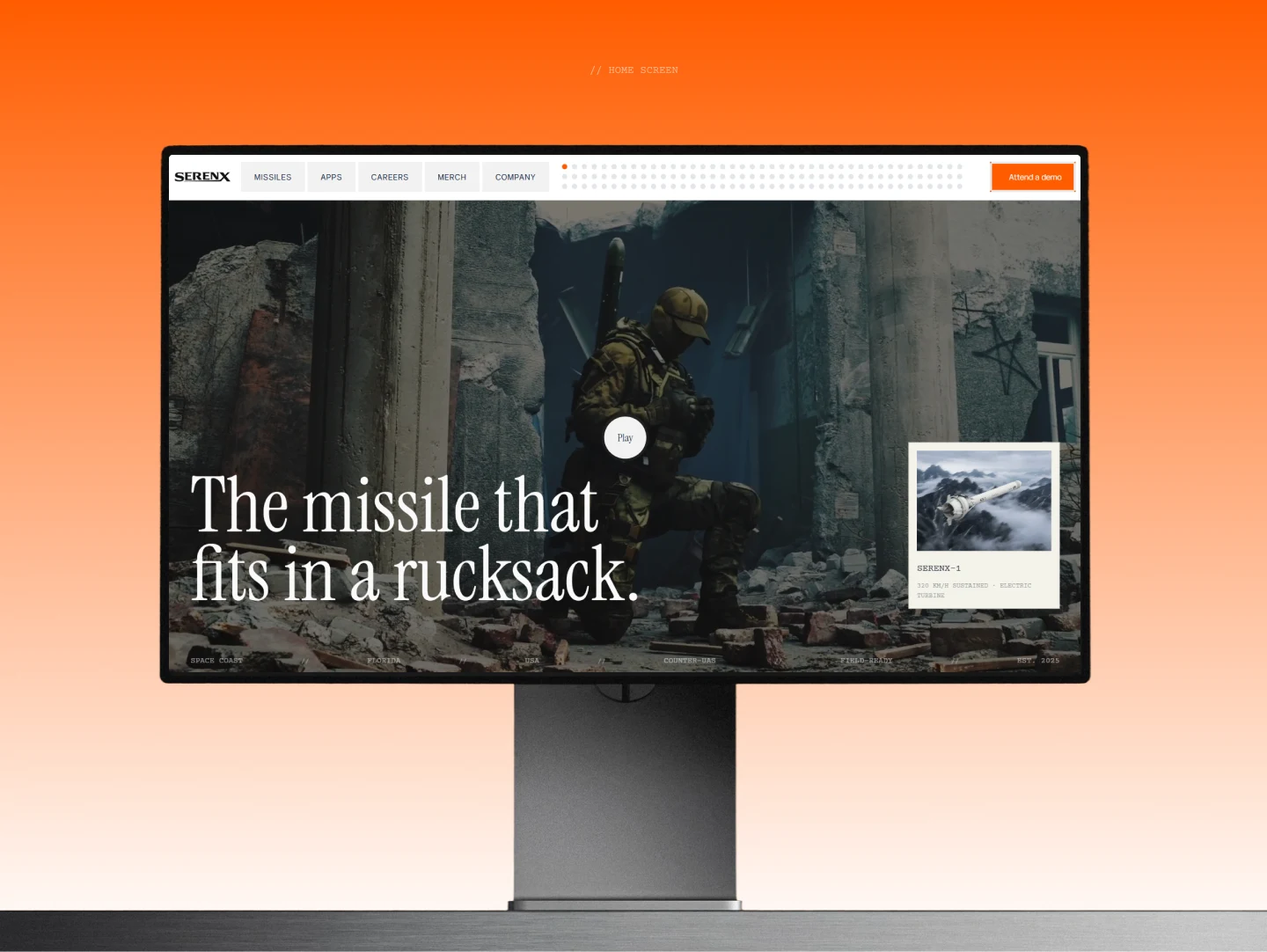
We are a UX/UI and branding studio founded in 2018. We have designed pitch decks for most of our clients, including Ply, JobCannon, SerenX and Bravo1Alpha.
Two of them have announced funding publicly. Ply raised $8.5 million in a strategic round led by Ferguson Ventures, with Primary and SignalFire taking part, announced on December 4, 2025 (citybiz). JobCannon announced a $500,000 pre-seed investment from Whitehill Capital on January 8, 2024 (Tech.eu). These are public facts about our clients, not results of our slides: the rounds were won by the founders.


Our work has won 60+ international design awards, including Red Dot, 18 Awwwards, 3 FWA and 25 CSS Design Awards, and I serve on the Awwwards jury.
- The call. You explain the product as if to an investor, and we hear what is clear and what gets lost. If you need one, we sign an NDA from the first call.
- The material. You send the content for each slide: text, numbers and visuals. We refine it, we don't write it from scratch.
- The design. We design up to 20 slides in your brand voice and colours, in Claude as an animated HTML deck or in Figma, and turn the hardest part of the product into one clear diagram.
- Revisions and delivery. Two rounds of small revisions, then you get the deck as a link, HTML files or a PDF, plus all the files. We keep backup copies.

The base timeline is about one week. Conversion to PowerPoint, Google Slides or Keynote costs extra. More than 20 slides, writing the story with you, 3D renders or extra motion change the scope, so we quote them after the first call. See the pitch deck design service page for how we work with defense, AI, SaaS and MedTech founders, or read our guide to the defense tech pitch deck.
Last updated: November 23, 2026. Vendor prices checked on November 23, 2026.
Pitch deck design services for defense, AI, SaaS and MedTech startups: decks that explain complex products to investors, with diagrams, 3D and motion.
FAQ
How much does pitch deck design cost?
In November 2026, vendors that publish prices charge from under $20 a slide for fix-ups to $6,000 or more for strategy, writing and design. Design-only decks cost about $800–2,500 at the vendors we checked. At Cosmos Studio a pitch deck starts from $1,000: you provide the content, we design up to 20 slides, with two rounds of small revisions.
How long does it take to design a pitch deck?
From a day to four weeks, depending on scope. Design-only services quote 24 hours to 4 business days; packages that include writing take from 7 days to about 4 weeks. At Cosmos Studio the base timeline is about one week, provided the text and numbers for each slide are ready when we start.
How many slides should a pitch deck have?
Up to 20 in total. The decks we design are usually up to 20 slides: a core of 12–16 that you send ahead, plus an appendix. Papermark's 2026 data shows 12-page decks get the most views, and completion falls from 60% at 8 pages to 38% at 20. For a live pitch, 8–10 slides is enough.
How long do investors spend reading a pitch deck?
Usually a minute or a few. Papermark's 2026 report found that half of views end within 77 seconds and the average view lasts 4.0 minutes. DocSend's weekly index showed 2:18–2:42 in 2023–2024. The often-quoted 3:44 comes from a 2015 DocSend study.
Does a well-designed pitch deck help you get funded?
It helps you get read. In a 2025 randomized trial with nearly 35,000 investors, Blaseg and Mayer found that better design raised time spent by 35% and positive reactions by 116%. Only better content raised the likelihood to invest. Design earns attention; your numbers and team close the round.
Should I use an AI tool, a template or a designer?
Use an AI tool or a template for a first draft and to check your structure. Hire a designer when the story is clear but the deck doesn't look credible, or when the product is hard to explain. Don't send a raw AI deck to investors: it looks like everyone else's.
What is included in the Cosmos Studio pitch deck package from $1,000?
We design the content you provide: up to 20 slides in your brand voice and colours, built in Claude as an animated HTML deck or in Figma. We refine the wording and the order, but we don't write the story from scratch. Two rounds of small revisions are included, and the base timeline is about one week.
In what format will I receive the deck?
As a link, which keeps the animation and is what I recommend, as HTML files or as a PDF. If you need PowerPoint, Google Slides or Keynote, we can convert it. Tell us the format you need; conversion to PowerPoint, Google Slides or Keynote is extra.
Do I get all the files of my pitch deck?
Yes. At the end of the project you get all the files of the deck, so you can present it, send it or edit it later. Cosmos Studio also keeps backup copies on its side, which helps when you need a quick update before the next round of investor meetings.
Should I send investors a PDF or a link?
A link is usually better. Papermark's 2026 report advises sharing a link, not an attached PDF, because you can track views, update the file and revoke access. It also found that 79% of founders send one link to everyone, which hides who actually read the deck.
Do you sign an NDA before seeing our deck?
Yes, if you need one. Cosmos Studio signs an NDA from the first call, before you share numbers, product screens or investor names. Decks for defense, AI and deep tech startups often carry sensitive data, so tell us when you book the call and we will sign yours or send ours first.
What should I prepare before hiring a pitch deck designer?
Your current deck or the text for each slide, the numbers you will show, brand assets such as logo, colours and fonts, product screenshots or photos, the deadline and the format you need. Add two or three decks you like. A complete brief is the fastest way to a one-week project.
Sources


Related articles
Start your project with Cosmos Studio™
Drop us a message, Anna reviews every brief personally and gets back to you within one business day. From there it's simple: we align on scope, sign the contract, and book your start date. Fast, clear, no back-and-forth.
