





Verified by Clutch™ reviews

Military and Defense UI/UX Design Services for Mission-Critical Products

Cosmos Studio designs and builds interfaces for defense products where clarity and speed directly affect operational outcomes. Our military and defense UI/UX design services cover GEOINT and IMINT platforms, ISR and intelligence tools, counter-UAS systems, and defense data platforms. One senior team handles research, UX, UI, and front-end development under a single contract and NDA.
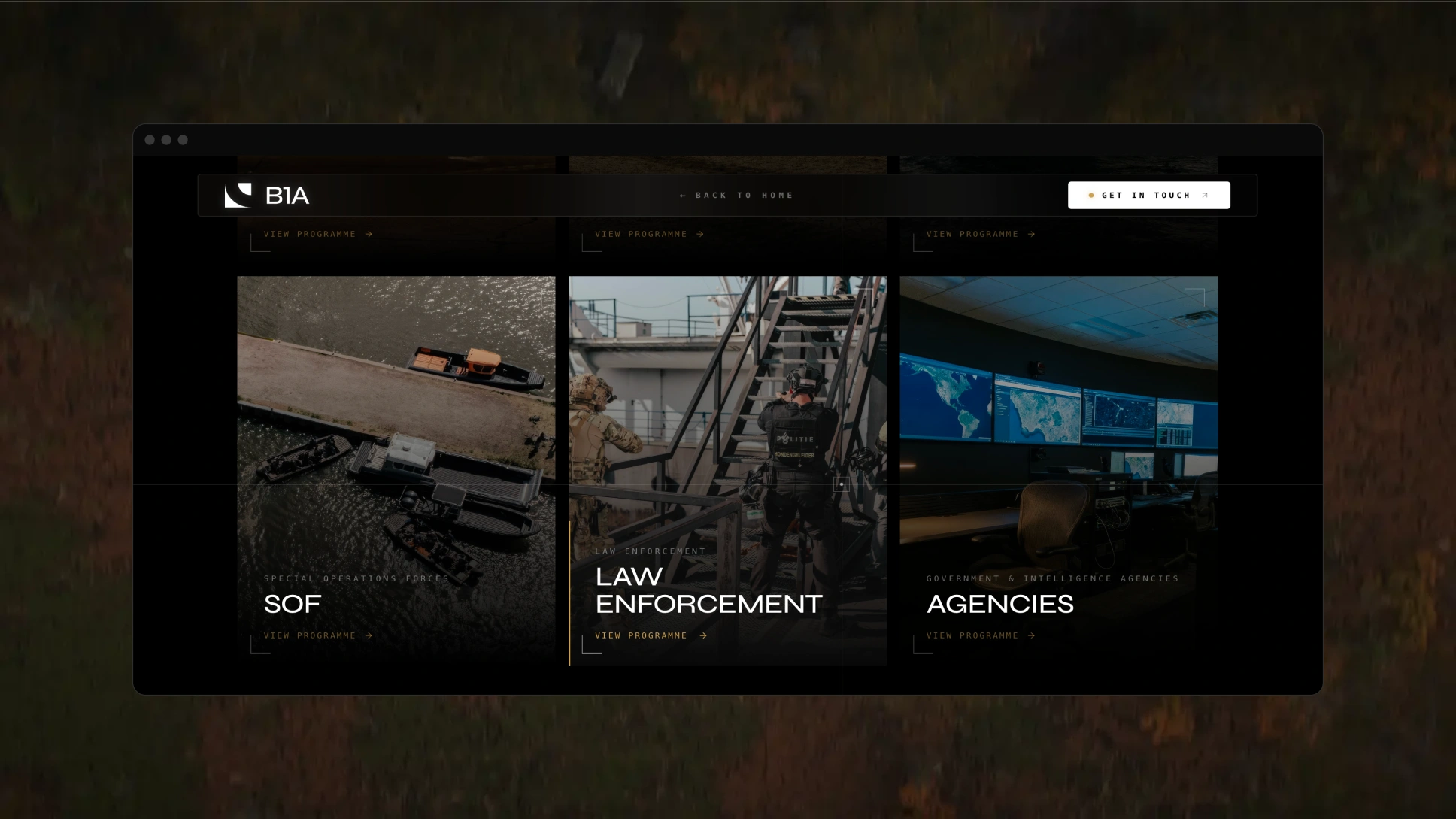
Bravo1Alpha defense website – SOF, law enforcement and agencies sections
500+
products launched
since 2018
60+
international
design awards
MIL-STD-2525
and NATO APP-6
symbology experience
NDA
from the
first call
We ARE

Defense tech design agency trusted by GEOINT and ISR teams

Cosmos Studio is a military UX design partner for defense technology companies, intelligence teams, dual-use startups, and government-facing organizations across the US and Europe. We begin each project by mapping user roles, permission levels, and operational contexts. This process gives analysts and operators the information and controls they need without adding unnecessary complexity. Founded in 2018, Cosmos Studio has a team of mid-level and senior designers and engineers who have contributed to 500+ digital product launches. Our longest-running defense partnership is with Bravo1Alpha, a European GEOINT and IMINT provider whose training methodology was battle-tested in Ukraine. We developed its brand identity, websites, and browser-based geospatial analysis platform for intelligence analysts.

TheFWA

3× FWA of the Day

Awwwards

18 awards. 4× Site of the Day

CSS DA

25× UI, UX, Innovation

Orpetron

4× SOTD, SOTM, OWDA

Red Dot Awards

1× Winner Brand identity

CSS Winner

5× Site of the Day, Dev Award

What we design

Military UX and UI design for the defense systems we build

Our military UX and UI design work focuses on products where a misread screen can delay action or increase risk. We most often design and build the following product types.

GEOINT and IMINT platform interfaces

From raw imagery to a structured report

We design map-based interfaces for electro-optical, multispectral, and SAR imagery, including large GeoTIFF files. Annotation tools, layer controls, and reporting workflows help analysts move from raw imagery to a structured report without switching between systems.

Product UX/UI design
Our principle

Data honesty: how we design interfaces analysts can trust

In defense systems, a polished interface displaying incorrect data can be more dangerous than a blank screen. That’s why Cosmos Studio applies one principle to every military UX project: never present unverified information as fact.

01

Every value shows its source

Analysts can see whether data comes from satellite imagery, a sensor feed, or a manual entry. This context helps them assess its reliability before using it in an analysis or briefing.

02

Precision matches the source data

Coordinates and measurements appear only at the precision at which they were captured. The interface never adds decimal places or formatting that implies more certainty than the source supports.

03

Missing data remains visible

When information is unavailable, the interface marks it clearly. We never replace gaps with plausible defaults that an operator could mistake for verified data.

04

Classification markings stay attached

Classification levels remain connected to the data at every stage, from the working interface to exported reports.

05

Built on NATO standards

Map annotations follow established interoperability standards, including MIL-STD-2525 and NATO APP-6 symbology. Analysts work with symbols that partner organizations and commanders already understand.

06

Every release requires approval

New versions move through separate preview and production environments. Nothing reaches analysts until the client has reviewed and approved the release.

Built for the field

How we design for operational conditions

Military UX must perform under conditions most software never faces: operator fatigue, time pressure, unreliable connectivity, and strict access controls. Cosmos Studio accounts for these constraints from the first workshop.

Fig 0.1

Roles and permission levels

Before designing a screen, we map every user role, permission level, and operational context. Analysts, commanders, and administrators receive interfaces built around their specific tasks. Role-based access ensures that users see only the data their clearance allows.

Fig 0.2

Lower cognitive load under pressure

Our military UI design keeps each screen focused on a specific decision. We organize information by priority, remove visual noise, and separate critical alerts from routine activity so operators can quickly find what matters.

Fig 0.3

Dark, high-contrast interfaces

We design dark, high-contrast visual systems for defense products and reserve accent colors for signals that require attention. This controlled use of color directs the operator’s focus without overwhelming the screen.

Fig 0.4

Offline and on-premises deployment

Not every operational environment has reliable internet access. Through our engineering network, Cosmos Studio supports on-premises and offline deployments, as well as AWS infrastructure when cloud access is available. Interfaces can remain available in closed or disconnected networks.

Works

Selected defense work

Cosmos Studio’s defense work spans intelligence platforms, brand systems, and websites that help defense companies win contracts and attract investors.

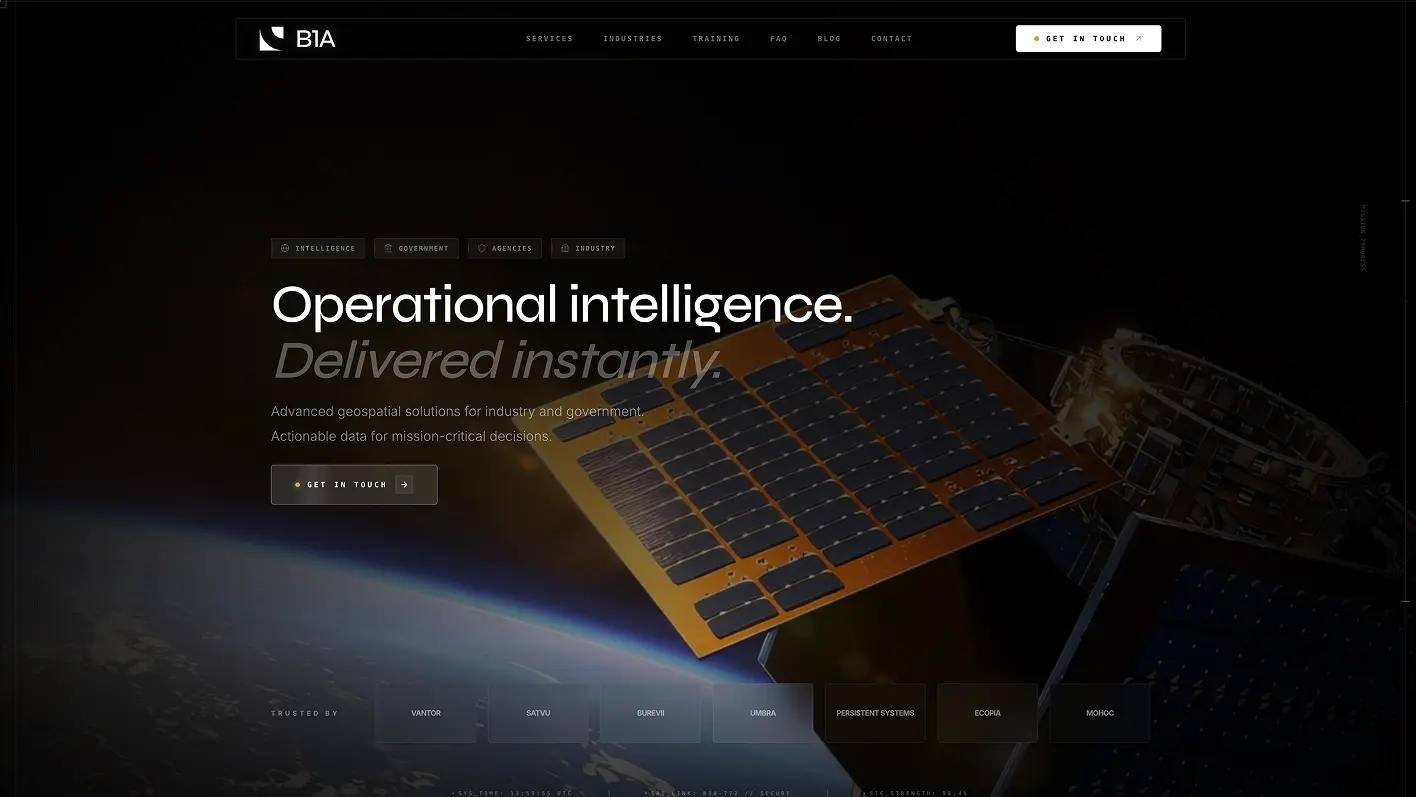
Bravo1Alpha GEOINT website hero – Operational intelligence, delivered instantly
European GEOINT and IMINT provider serving government, defense, and security organizations

Bravo1Alpha: brand, websites and a geospatial analysis platform

Geospatial platformBrand identityWebsitesWebGL

Cosmos Studio is Bravo1Alpha’s sole creative and engineering partner. We built a browser-based analysis platform for electro-optical, multispectral, and SAR imagery, with MIL-STD-2525 annotations and structured reporting. We also created its brand identity, defense website, tactical satellite support and ISR product site, WebGL multi-domain operations experience, and space-enabled operations qualification site.

Stack: React, TypeScript, Vite, Tailwind CSS, Framer Motion, GSAP, and Three.js
See the case

Under NDA

US defense hardware startup: design system and product website

Visual languageDesign systemProduct websiteWebGL

We built the company’s digital presence, including an engineering-led visual language inspired by industrial and aerospace design, a unified design system, and a multi-page product website with a reusable, data-driven template for the full product line. Confidential pre-launch reviews took place in separate, access-controlled preview and production environments.

Stack: React, TypeScript, Vite, Tailwind CSS, GSAP, ScrollTrigger, and WebGL
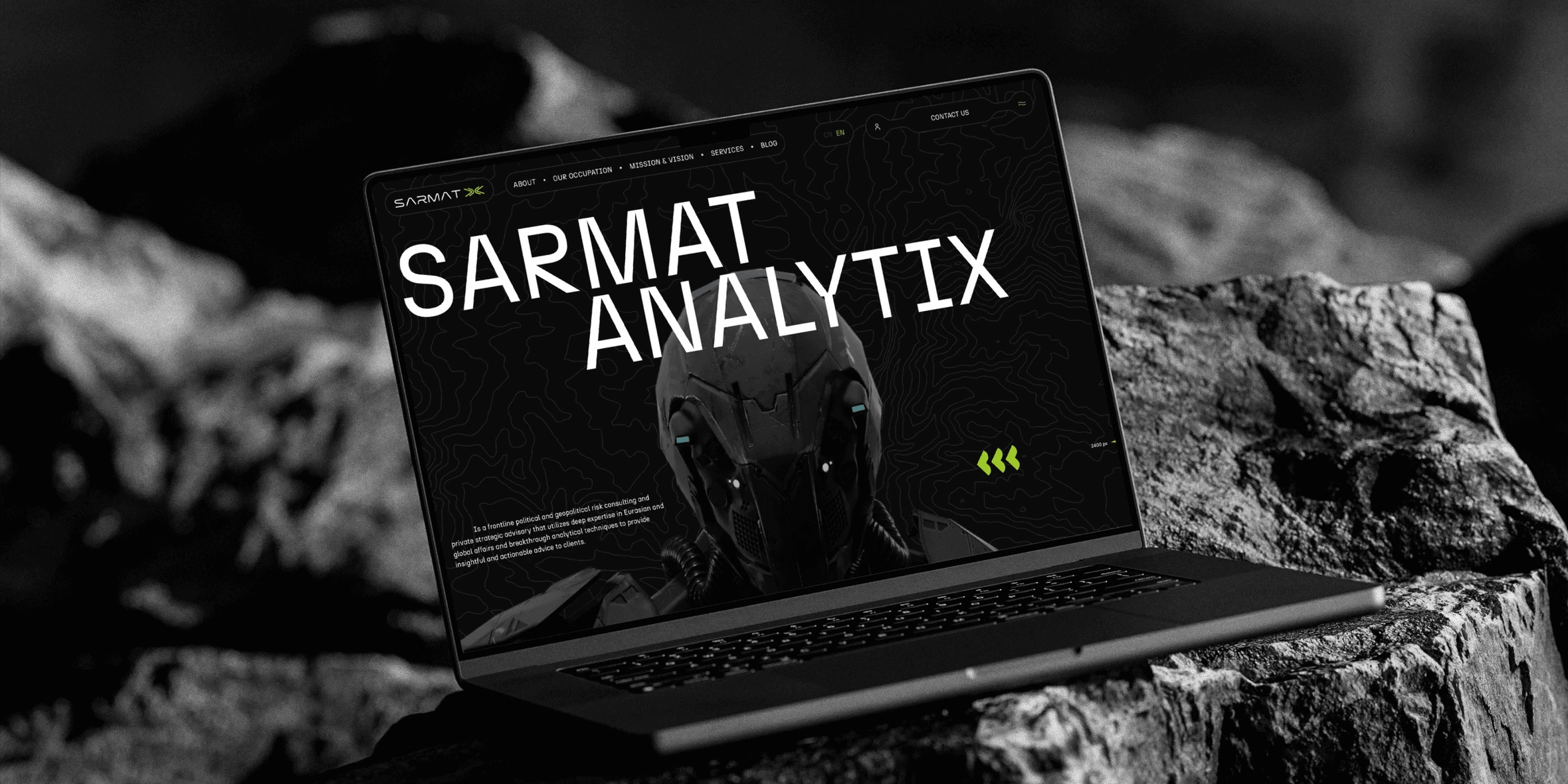
Sarmat Analytix brand identity and website by Cosmos Studio
Consulting firm specializing in political and geopolitical risk, security, and strategic advisory

Sarmat Analytix: brand identity and website for a geopolitical risk consultancy

Brand identityWebsite UX/UIMobile adaptationMotion design

Together with Obriy Design Büro, Cosmos Studio created the Sarmat Analytix brand and website, drawing on science fiction, military robotics, and defense technology. The logo combines the Sarmat name with the X in Analytix, supported by a dark palette, acid-green accents, and a modular visual system. The website extends this identity through a cinematic hero section, motion and 3D graphics, and a strict grid that makes complex analysis easy to scan on desktop and mobile.

See the case
Skylight cybersecurity website hero – Simple and effective cloud data protection
Cybersecurity company providing cloud data protection

Skylight: cybersecurity website UX/UI design

Website UX/UIAnimationBlog system

We designed a website that explains a data protection API through animation, a clear structure, and a flexible blog system.

See the case
Anna Shestakova, Business Developer at Cosmos Studio
Anna ShestakovaBusiness Developer, Cosmos Studio
Talk to us

Building a GEOINT, ISR, or counter-UAS product?

Talk to the team behind Bravo1Alpha’s geospatial analysis platform. NDA from the first call.

Book a Discovery Call
NDA from the first call
Brand and web

Defense web design and branding that wins buyers and investors

Defense companies must earn the confidence of procurement teams, investors, and future hires, often before they can show the product itself. Cosmos Studio creates brands and websites that communicate technical credibility and operational value with the same precision we apply to mission-critical interfaces.

Defense brand identity

Logo systems, visual languages, and brand guidelines for defense companies and individual product lines. We create engineering-led identities with restrained palettes and precise technical typography that build credibility with government buyers and investors.

Defense web design and development

Our military website design services explain complex capabilities without exposing confidential information. We design and develop multi-page company sites, product sites with reusable templates, and scroll-driven WebGL experiences. Production front ends use React and TypeScript.

Pitch decks and government presentations

We design investor decks and presentations for government and defense audiences using the same visual system as the brand and website. This keeps the messaging and visual language consistent across every touchpoint.

Confidential pre-launch delivery

Websites for unannounced products remain in separate, access-controlled preview environments until the client reviews and approves the public launch.

Our process

From research to production under one contract

Cosmos Studio covers the full product lifecycle with one accountable team and one point of contact, regardless of project size. A typical engagement takes around 4–8 weeks from the initial brief to delivery, followed by ongoing support.

+10 experts
~4–8 weeks brief to delivery
One team, one point of contact

How a project runs

01Cosmos

Brief and scope

We align on objectives, users, constraints, and confidentiality requirements.

02Cosmos

Research and UX strategy

We map user roles, permission levels, operational contexts, and workflows.

03Cosmos

Information architecture and prototypes

We define the product structure and test key workflows before visual design begins.

04Cosmos

UI design and design system

We create the screens, reusable components, and design system your team needs to scale the product.

05Cosmos

Usability testing

We test the interface against representative tasks before development.

06Cosmos

Front-end engineering and handoff

We deliver production-ready code or a complete handoff package for your developers.

07Cosmos + network

Ongoing support

Releases move through separate preview and production environments, with client approval before launch.

→

Start with a discovery call

We confirm scope, constraints, and an estimate after the call.

Book a Discovery Call →

What we build in-house Cosmos

Our team develops production front ends in React, Next.js, and TypeScript. This includes map-heavy GEOINT interfaces, 3D and WebGL visualizations, and real-time data dashboards.

ReactNext.jsTypeScriptWebGLThree.js

What our engineering network adds Partners

Our vetted senior engineering network covers backend systems and APIs, mobile apps, and AWS cloud infrastructure, plus on-premises and offline deployments for closed or disconnected environments.

Node.jsPythonSupabaseFirebaseReact NativeFlutterSwiftKotlinAWSOn-prem / offline
Why Cosmos Studio

Why teams building defense products choose Cosmos Studio

01

Senior team only

Every designer assigned to client work has more than 5 years of product design experience. We don’t place junior designers on client projects, and every deliverable goes through art director review. Quality control is our responsibility, not yours.

02

Led by an Awwwards jury member

Founder and CEO Illia Kulbachnyi has more than 11 years of experience in UI/UX and product design and serves on the Awwwards jury. Cosmos Studio has received over 60 international design awards, including 18 Awwwards, 25 CSS Design Awards, three FWA of the Day awards, and a Red Dot Award for brand identity.

03

Confidential by default

Every project can operate under an NDA. From the first call, we adapt communication, file access, documentation, and collaboration processes to the client’s security and confidentiality requirements.

04

We think in terms of the operator

We evaluate every decision through operator workload and decision speed. If a screen looks polished but slows the user down, we explain the problem and propose a better approach.

Trusted by product teams across the US and Europe

4
4
2
3
4
3
7
4
7
8
0
6
7

Projects successfully launched for clients

2
8
7
8
9
1

Years in Web & UX Design

6
6
2
3
4
5
6
8
0
3
4
5
6
7
0
+

International Design Awards

Before you book a call

Is Cosmos Studio the right military UX design partner for you?

Strong fit

We’re a strong fit if:

  • 01Your analysts work with growing volumes of imagery and sensor data, but tool switching, unclear data provenance, and cluttered interfaces slow analysis and reduce confidence.
  • 02Your product serves analysts, commanders, and administrators with different tasks and permission levels. A single interface forces every role to work through information and controls they don’t need.
  • 03Your technology is ready for procurement teams and investors, but your brand, website, and pitch materials don’t yet communicate its technical depth or operational value.

Sounds like your team?

Book a Discovery Call
Not a fit

We’re probably not the right choice if:

Your project requires a team inside classified networks or a vendor with specific government security certifications.

We can still helpIn that case, we can still design and build the unclassified parts that can be developed outside those environments.
FAQ

Frequently asked questions

1

What types of military and defense products do you design?

We design UX and UI for GEOINT and IMINT platforms, ISR and intelligence tools, counter-UAS and command and control interfaces, mission planning tools, and defense data platforms. Users often act on this information under time pressure, so a confusing interface can delay or lead to incorrect decisions.

We also create brands, websites, and pitch materials for defense companies. Even a strong product must earn procurement teams’ and investors’ confidence before anyone uses it.

2

How much do military and defense UI/UX design services cost?

Projects start at $5,000, with hourly rates beginning at $50. Specialized senior roles, such as AWS cloud architects, can cost up to $170 per hour.

The main cost drivers are the number of user roles, data complexity, system integrations, and security requirements, not the number of screens. After the discovery call, we provide an estimate based on the confirmed scope.

3

How long does a defense UX project take?

A typical engagement takes around 4–8 weeks from the initial brief to delivery, followed by ongoing support.

The first stage covers research and the mapping of user roles, permissions, and workflows. Larger platforms are delivered in stages. Each release moves through a separate preview environment for client review before reaching production.

4

Can you work with complex and data-heavy systems?

Yes. Data-heavy platforms are a core part of our defense work.

We developed a browser-based geospatial analysis platform for electro-optical, multispectral, and SAR imagery, including large GeoTIFF files. The platform also turns analysts’ annotations into structured reports.

The main design challenge is deciding what each user needs immediately, what can wait one click, and what must always remain visible. We structure interfaces around those priorities rather than the database.

5

How do you make sure analysts can trust what the interface shows?

We follow a data honesty principle: an interface should never present unverified information as fact.

Every value shows its source, coordinate precision reflects how the data was captured, and missing fields remain visibly empty instead of displaying plausible defaults. Classification markings also remain attached to data in exported reports. These details help analysts assess information without having to check it again in another system.

6

Do you design with NATO symbology standards?

Yes. We design map annotation and situational awareness interfaces using recognized military symbology standards, including MIL-STD-2525 and NATO APP-6.

Standard symbols help analysts, partner organizations, and commanders interpret the same map consistently. We introduce custom symbols only when the established standards do not cover a specific operational need.

7

Do you design for different user roles and permission levels?

Yes. We map roles and permissions at the start of every project.

Analysts, commanders, and system administrators use the same product for different tasks. Giving everyone the same interface creates unnecessary clutter and may expose information or controls a role does not need. We design each view around the user’s task, operational context, and access level.

8

Can you build interfaces for offline or air-gapped environments?

Yes. Through our engineering network, we support on-premises and offline deployments for disconnected or air-gapped environments. We also provide AWS cloud infrastructure when cloud access is permitted.

Offline UX involves more than hosting. The interface must distinguish current, previously synchronized, and unavailable data so users never mistake stale information for a live update.

9

Can you redesign an existing military or defense product?

Yes. We begin with a UX audit to identify slow workflows, recurring workarounds, unclear interface states, and information users struggle to find.

We then redesign the experience in stages without disrupting core functionality. This approach suits fielded products that must remain available throughout the redesign.

10

Can you handle the entire production process?

Yes. Cosmos Studio handles research, UX strategy, UI design, design systems, and production front-end engineering in-house. Our technology stack includes React, Next.js, and TypeScript for map-heavy interfaces, real-time dashboards, and 3D and WebGL visualizations.

Our vetted senior engineering network provides backend, mobile, and cloud development under the same contract. Clients work with one accountable team and one point of contact throughout delivery.

11

Can you work with our existing engineering team?

Yes. We can deliver production front-end code or a developer-ready handoff, depending on your team’s needs.

A handoff can include a structured Figma file, consistent component naming, a documented design system, and interactive prototypes. For defense companies with strong engineers but no dedicated product designers, we can operate as the design function within existing development sprints.

12

Can you work on confidential or NDA-protected defense projects?

Yes. Every project can operate under an NDA from the first call. We adapt communication, file access, collaboration, and documentation to each client’s security requirements.

Pre-launch work remains in separate, access-controlled preview environments until the client approves publication. Some of our defense work, including the complete digital presence of a US defense hardware startup, has been delivered entirely under NDA.

Book a Discovery Call
3D figure illustration for the FAQ section
lET'S TALK

Start your project with Cosmos™

Drop us a message, Anna reviews every brief personally and gets back to you within one business day. From there it's simple: we align on scope, sign the contract, and book your start date. Fast, clear, no back-and-forth.

Thank you
Your submission has been received!
Oops! Something went wrong while submitting the form.