GPT-6.2 Astra and Sol, Gemini 4 Neon, Microsoft Today – AI & Design Weekly #9


GPT-6.2 Astra and Sol, Gemini 4 Neon, MAI Image 2.7 and Canvas, Microsoft Today, Genie 4, AI chip design at AMD, ICEYE bids for Avio: November 17–20, 2026.
Key takeaways:
- OpenAI released GPT-6.2 Astra ($8/$40 per million tokens, 20% below GPT-6 Astra) and GPT-6.2 Sol ($2/$10) in ChatGPT Work, Codex and the API.
- Google released Gemini 4 Neon at $3/$15 per million tokens; Google reports #3 on the Artificial Analysis Intelligence Index and #1 on its Coding Agent Index.
- Microsoft put MAI Image 2.7 and Flash in public preview and launched Canvas, where you select part of an image to replace, move or restyle.
- Microsoft Today prepares a morning brief and drafts in Outlook and Copilot for you to approve; it is in private preview.
- OpenAI reports up to 14% gains on AMD's flagship GPU IP; its models also rewrote RTL verified with Synopsys tools, and some changes are in a design sent for manufacturing.
Twice a week I pick the AI and design news that matter to people who build products. This issue is about AI that does the prep work before you ask: a morning brief that is ready when you open Outlook, models priced for long agent jobs, an image editor where you point at the part you want changed, and a model that proposes chip design changes that an engineer can check. The design question is the same each time – how does a person review what the AI already did, fast and with confidence.
1. OpenAI releases GPT-6.2 Astra and GPT-6.2 Sol

On November 17 OpenAI released two models. GPT-6.2 Astra is meant for the hardest projects, and GPT-6.2 Sol for everyday work. Both are available now to Plus, Pro, Enterprise and Edu users in ChatGPT Work and Codex (Enterprise and Edu admins turn them on), and in the API as gpt-6.2-astra and gpt-6.2-sol. Astra costs $8 per million input tokens and $40 per million output tokens, 20% less than GPT-6 Astra, with cached input at $0.40. Sol stays at $2 and $10.
Why it matters: two tiers from one vendor make a clear product choice: send long, high-stakes tasks to the expensive model and the rest to the cheap one. That routing is a design decision as much as an engineering one, because users notice when an answer is slower or weaker. Decide it per feature, and show users when a task is running on the "deep" path. We help teams make these calls in AI product design.
Source: OpenAI: introducing GPT-6.2 Astra and Sol
2. Google launches Gemini 4 Neon for coding, analysis and agent work
On November 18 Google released Gemini 4 Neon. Google calls it frontier-level and says it sits just behind larger, slower models. It costs $3 per million input tokens and $15 per million output tokens, with a 1M-token context. Google reports third place on the Artificial Analysis Intelligence Index (61 at its highest reasoning setting) and first place on the Artificial Analysis Coding Agent Index (58.6). Artificial Analysis itself places Neon behind GPT-6.2 Astra and Claude Fable 5.2 overall. Neon is rolling out in the Gemini API and AI Studio, Gemini for business, Antigravity for paid AI Pro and Ultra subscribers, and the Gemini app for Pro and Ultra.
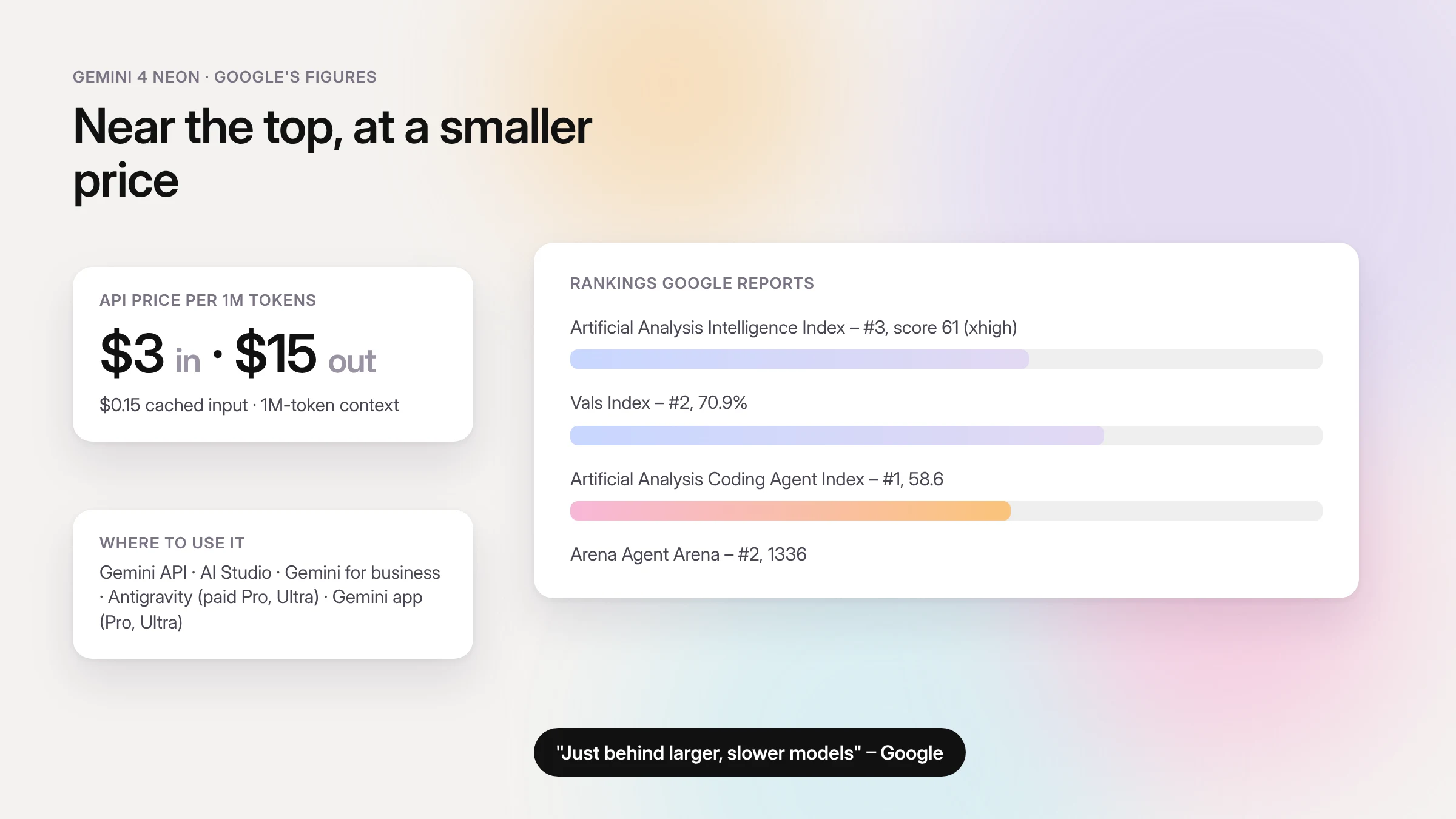
Why it matters: three big model launches from three labs in one week means the "best model" changes every few weeks. Products that hard-code one model pay for it later. Build the AI layer so you can switch models per feature and compare results on your own tasks, not only on public leaderboards. That is how we set up AI product design projects. Rankings here are Google's and Artificial Analysis's own.
Sources: Google: introducing Gemini 4 Neon; Artificial Analysis
3. Microsoft releases MAI Image 2.7 and Canvas, an editor where you select what to change
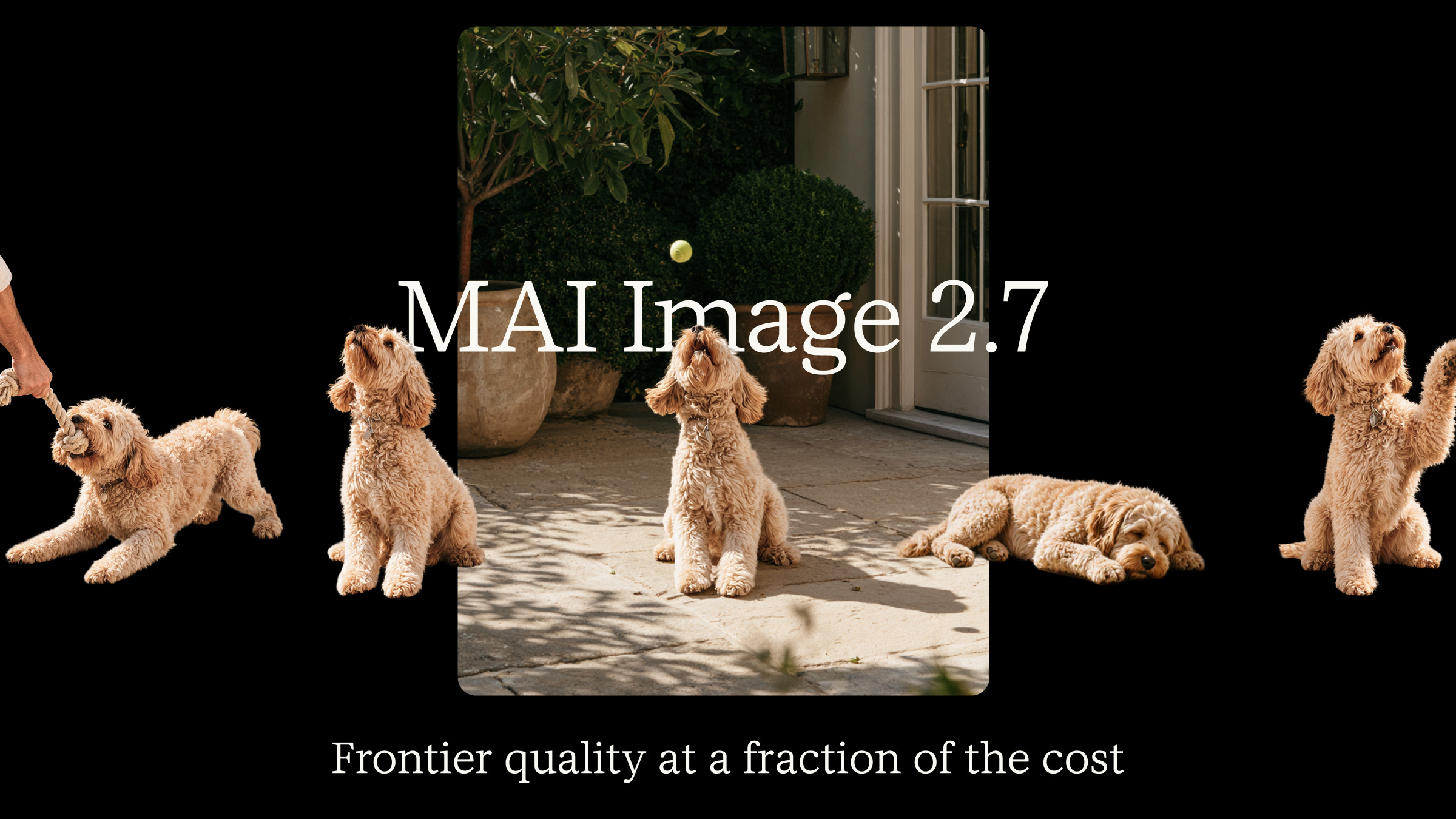
Microsoft AI released MAI Image 2.7 and MAI Image 2.7 Flash in public preview on Microsoft Foundry, and through partners fal, OpenRouter, Vercel and Genspark. The preview price is about $35 per 1,000 images for 2.7 and about $10 for Flash, and both models can output transparent backgrounds. Microsoft says MAI Image 2.7 ranks first on the Artificial Analysis image editing leaderboard. In MAI Labs it also launched Canvas, a workspace that runs on 2.7 Flash: you start from a prompt or a sketch, then select part of the image to replace, move or restyle it.
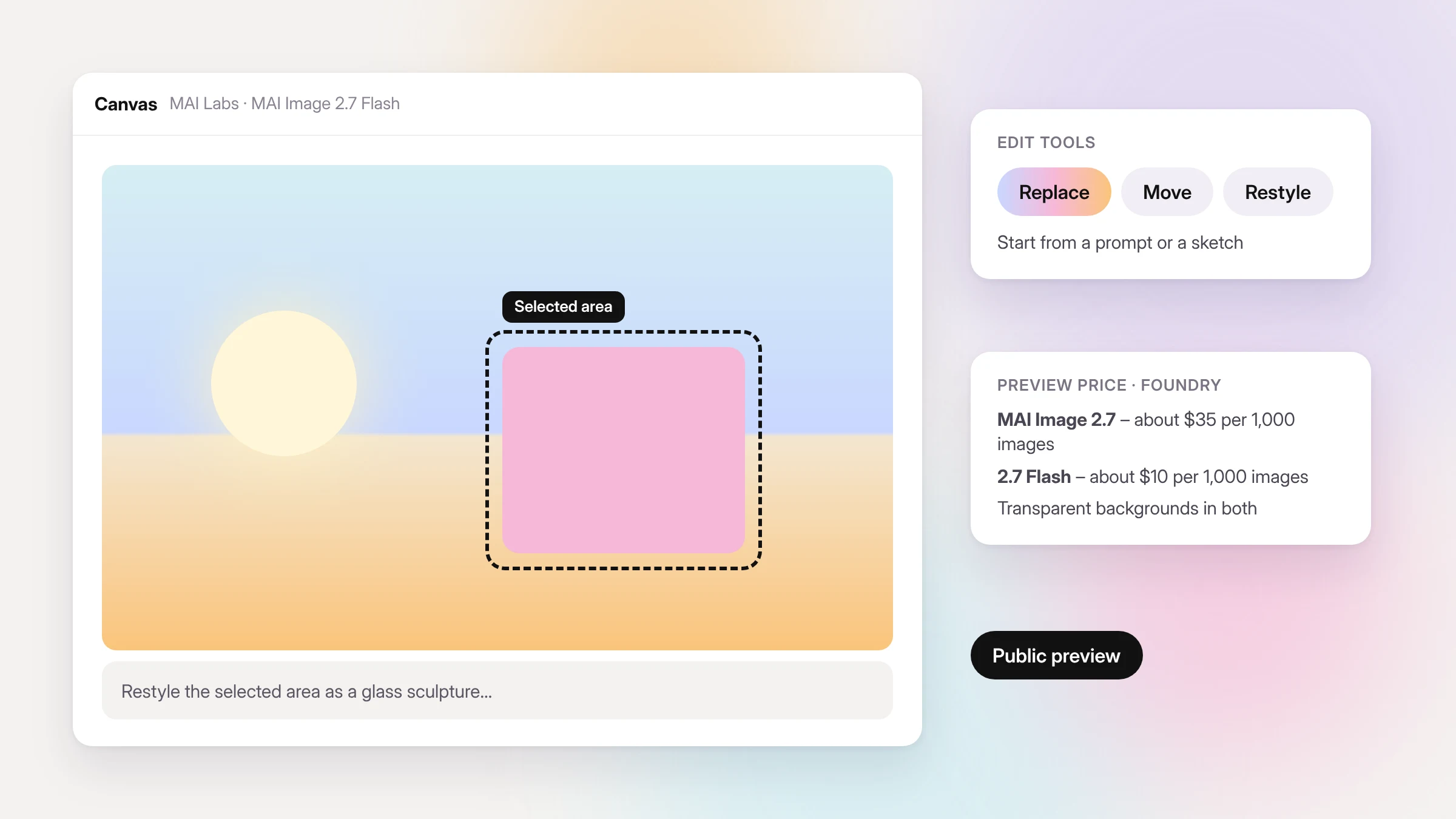
Why it matters: "select, then describe the change" is becoming a common way to edit with AI, because a full re-prompt throws away the parts you liked. If your product has any image or layout editing, plan for region selection, a short prompt and an easy undo, not one big text box. Transparent backgrounds also make these images usable as real UI and brand assets. We design editing flows like this in product UX/UI design.
Source: Microsoft AI: introducing MAI Image 2.7
{{newsletter}}
4. Microsoft shows Today, a morning brief in Outlook and Copilot that prepares your next steps
At Ignite on November 17 Microsoft introduced Today, part of Copilot Home. It looks across mail, calendar, Teams threads, meetings and tasks, and prepares drafts and schedule changes for you to approve. Today Brief is a morning briefing included with a Microsoft 365 Copilot license. Today Feed refreshes during the day and uses Copilot credits. Today is rolling out in private preview in the Copilot app and Outlook through Microsoft's Frontier program, with no date for general availability.
Why it matters: this moves AI from "answer my question" to "here is what I already prepared". The hard part is the review screen: people must see in seconds what changed, why, and what happens if they press approve. If your product can prepare work in the background, design the morning view and the approve or edit step first. This is core to our AI agent UX work.
Illia's take: The interesting part is not the AI, it is the timing. Today does the work before you open the app, so the first screen of the day becomes a review queue. Teams building B2B products should ask: what could our product prepare overnight, and what would the person need to see to approve it in one tap?
Sources: Microsoft Ignite 2026 Book of News; Microsoft Copilot Blog
5. Google DeepMind rolls out Genie 4 and a gallery of worlds you can remix
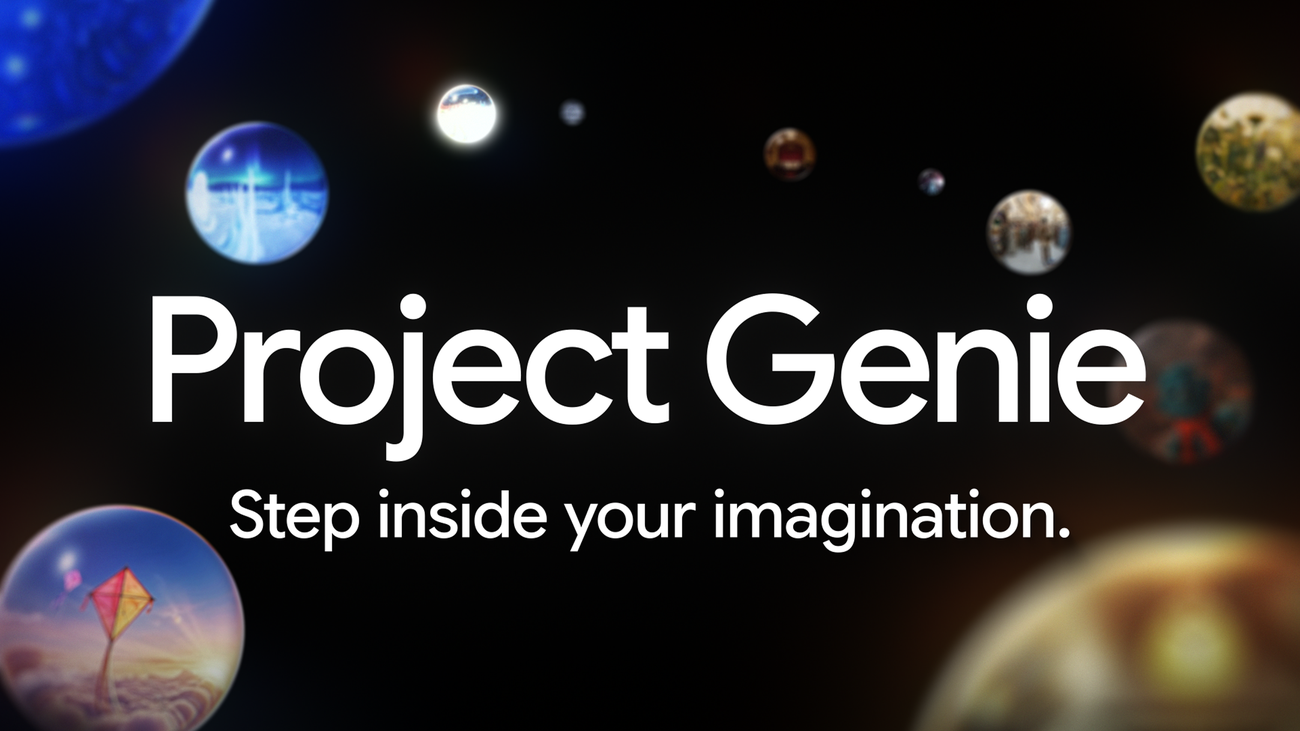
On November 18 Google DeepMind updated Project Genie, its tool for generating interactive worlds. Genie 4 lets you change a world in real time with a prompt and adds native audio. Genie 3 also got longer sessions of up to three minutes and can start from a 360-degree panorama. A new community gallery lets people publish, explore and remix worlds, with examples such as "Villa Giallo" and "The Life of Ants". Genie 4 is rolling out to eligible Google AI Ultra subscribers; AI Pro members can join a waitlist.
Why it matters: a gallery with remix turns a model demo into a creative platform, like templates did for design tools. For brands and studios this points to a new kind of asset: an interactive scene people can explore, not only a video they watch. It is early and limited to top-tier subscribers, so treat it as a prototype tool for now. We follow this space in 3D, video and motion production.
Source: Google: Genie 4 now available in Project Genie
6. OpenAI's models proposed chip design changes that AMD is already using
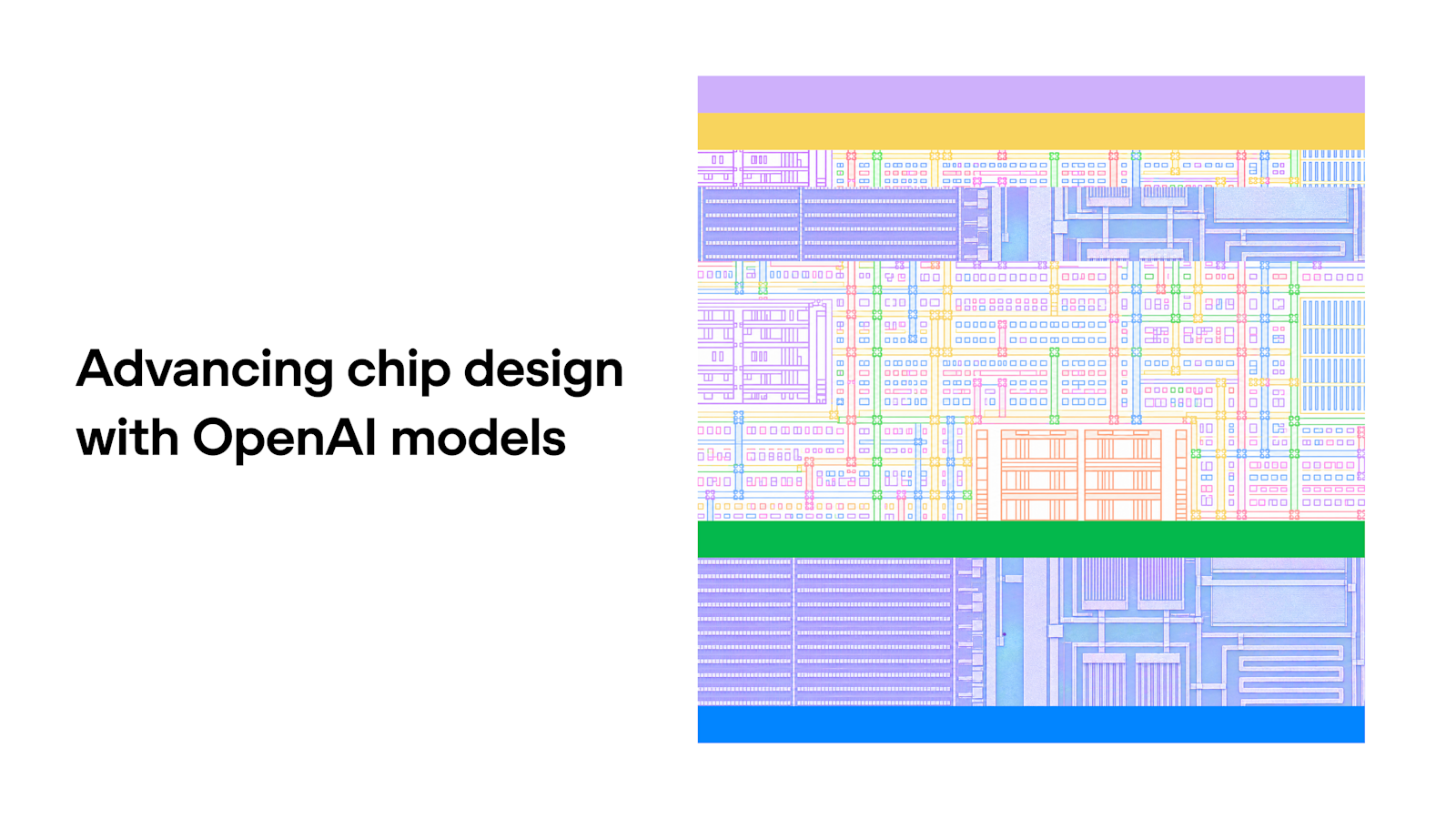
On November 18 OpenAI said its models rewrote hardware design code (SystemVerilog RTL) for AMD. Each rewrite was checked with Synopsys tools to confirm it behaves the same and to measure power, performance and area. OpenAI reports gains of up to 14% on AMD's flagship GPU IP compared with heavily optimized baselines, and AMD verified single-digit percentage gains on key blocks of its next flagship CPU. AMD has already included some of the changes in a recent design sent for manufacturing. OpenAI also says it is working with Synopsys to train GPT-Synopsys, a specialized chip design model announced in September; it is not available yet.
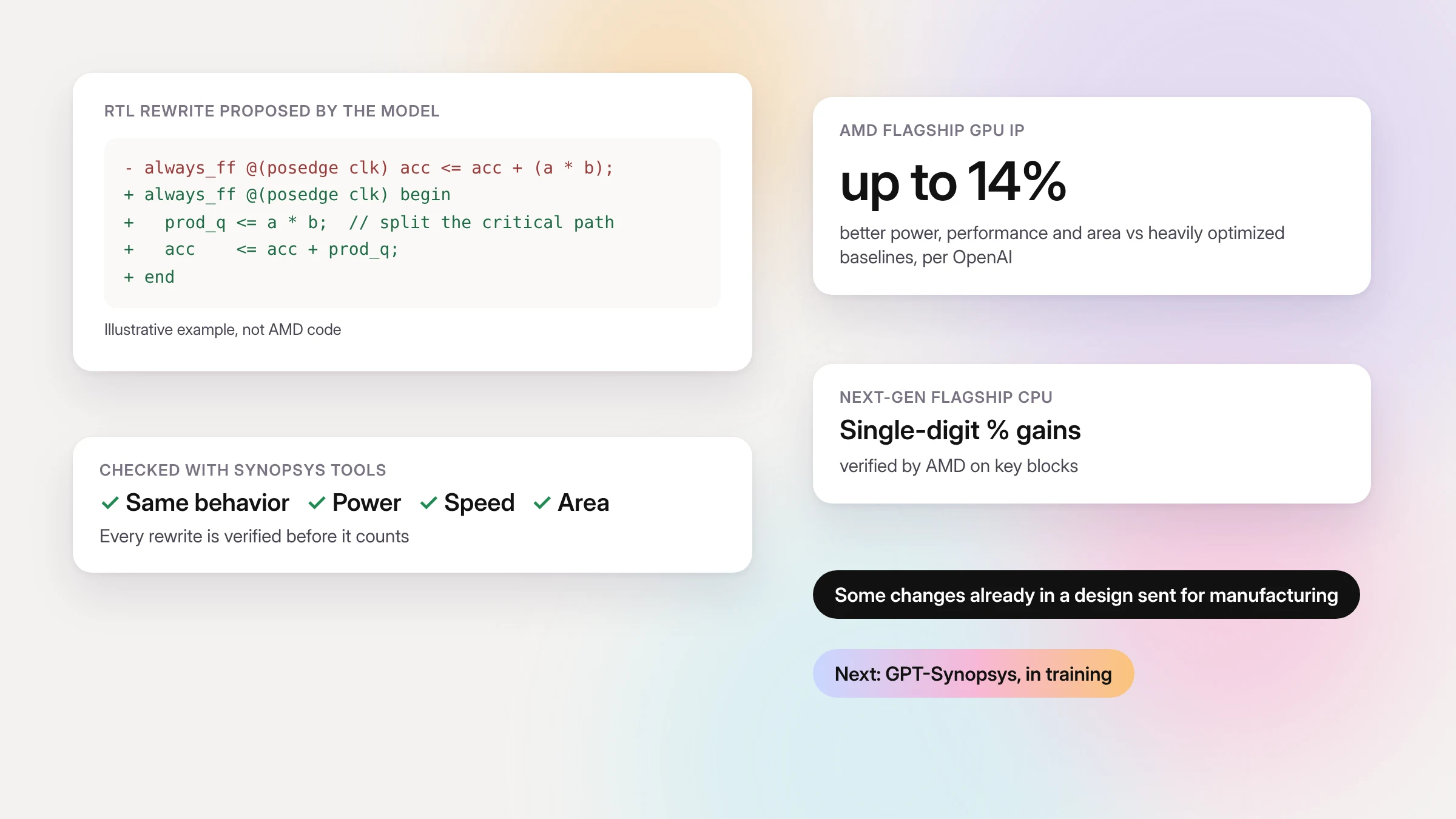
Why it matters: the pattern here works far beyond chips: the model proposes, an independent tool verifies, an expert decides. Any product that lets AI change serious work – code, contracts, financial models, designs – needs that same loop, with the check results shown next to the change. We design these review flows in AI agent UX. The gains are OpenAI's and AMD's own figures.
Sources: OpenAI: advancing chip design with our models; Synopsys
7. ICEYE offers about €2 billion for Italian rocket maker Avio

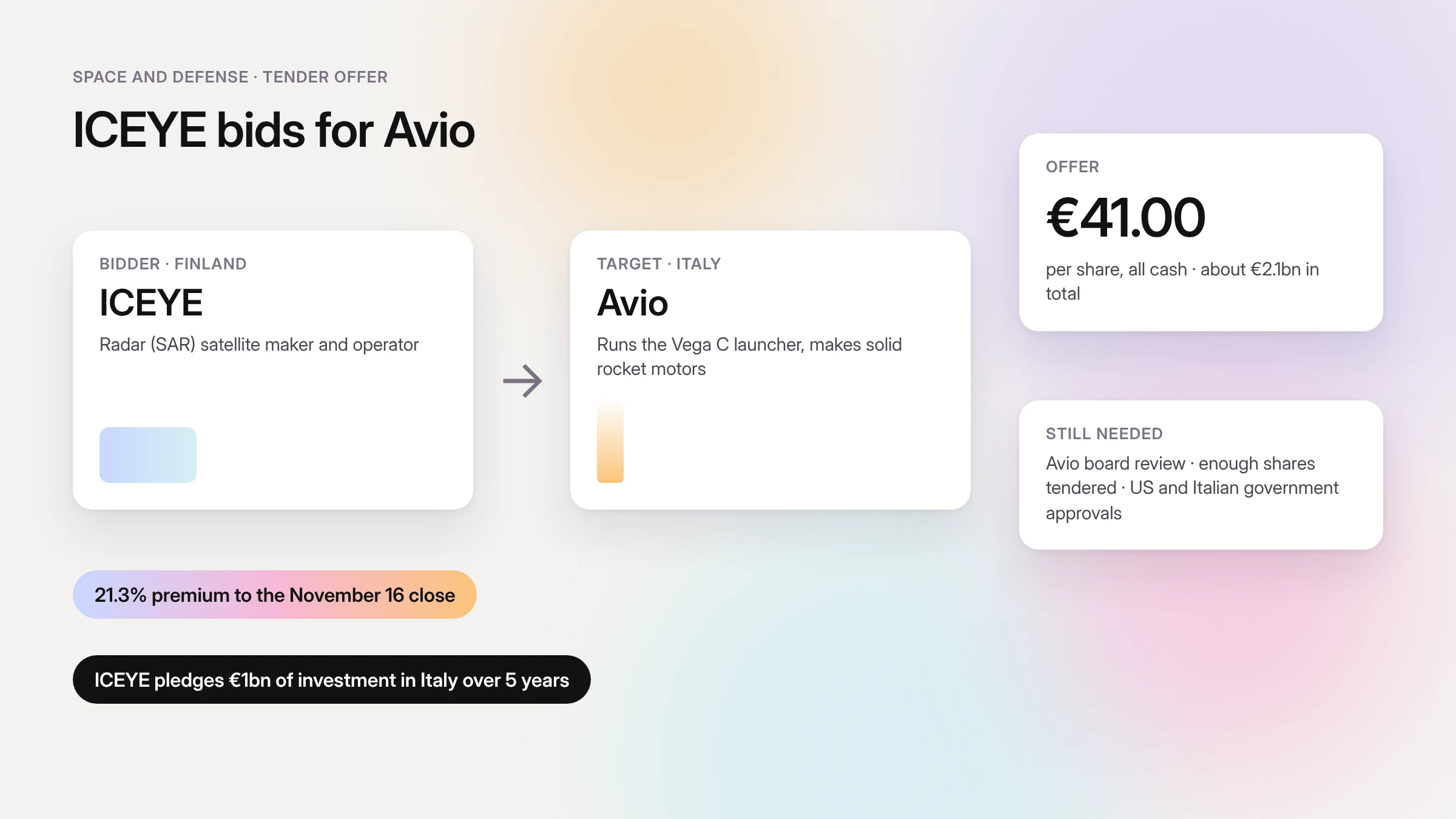
On November 17 Finnish radar satellite company ICEYE launched an all-cash tender offer for all shares of Avio, through its Italian subsidiary Iris 2. It offers €41.00 per share, a 21.3% premium to the November 16 close, which values Avio at about €2.05–2.1 billion, and it aims to take Avio off the Milan stock exchange. Avio runs the Vega C launcher and makes solid rocket motors. ICEYE pledges €1 billion of investment in Avio in Italy over five years. The offer needs US and Italian government approvals, and Avio's board has only started to assess it.
Why it matters: European space and defense companies are consolidating into larger groups that own more of the chain, from satellites to launch. When companies merge, so do their software, data products and brands, and operators end up with several consoles that should feel like one. We design for this in space and GEOINT UI/UX and defense tech website design.
Sources: Avio press release; Defense News
{{case}}
Also this week
- Anthropic priced its IPO at $83 per share on November 18, above the planned $70–78 range, raising about $81.3 billion, and started trading on Nasdaq as ANT on November 19, where it closed at $97.17 on day one, up 17%. Reuters: pricing, debut
- Perplexity added voice mode to its teammates agent on iOS and Android, so you can hand off a task by voice; it is available to Max subscribers. Perplexity
- NVIDIA reported $115.8 billion in quarterly revenue, up 103% from a year earlier, with $107.6 billion from data centers, and said Vera Rubin NVL72 systems have started shipping. NVIDIA
At Cosmos Studio we design AI products, agent flows and operator consoles for SaaS and defense-tech teams. See our work, and if your product is starting to prepare work for people before they ask, let's talk about the review step.
{{contact}}
We design AI agents people trust: approvals, task progress, logs, permissions and error recovery. Senior UX/UI and React front-end for agentic products.
FAQ
What is AI & Design Weekly?
A twice-weekly digest by Illia Kulbachnyi and the Cosmos Studio team with the AI and design news that matter to teams building SaaS, AI and defense-tech products.
How do you pick the stories?
We read 30+ design, AI and defense-tech sources and check every claim against the original source. When only a secondary source confirms a detail, we say so under the story.
How should a product show work an AI prepared in the background?
Group it into one review view, show each item as "prepared, not done" in plain words, and make approve, edit and dismiss one tap each. Show what will happen after approval and keep a history the person can check later. We design these flows in AI agent UX design projects; book a call to discuss yours.


Related articles
Start your project with Cosmos Studio™
Drop us a message, Anna reviews every brief personally and gets back to you within one business day. From there it's simple: we align on scope, sign the contract, and book your start date. Fast, clear, no back-and-forth.
